
Green Light Therapy May Help Reduce Surface-Level Dark Spots and Skin Inflammation

Green light therapy is a non-invasive skin treatment.
It may help reduce the appearance of dark spots and skin pigmentation, lower inflammation, and promote wound healing.
Research on green light therapy is in its early stages. Consult a dermatologist to discuss possible risks and side effects before starting light therapy.
Beauty influencers popularized at-home red light therapy treatments for more “youthful” skin. But a new option has entered the chat: green light therapy.
Green light has a shorter wavelength than red light, targeting skin concerns in the superficial layers, such as hyperpigmentation (dark spots) and inflammation.
What Is Green Light Therapy?
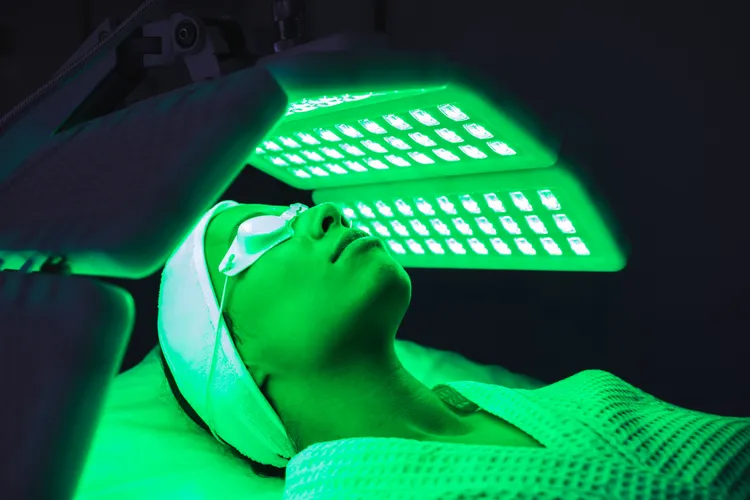
Similar to red light therapy, green light therapy involves exposing your skin to green light rays with a specialized device. The key difference between the two is that green light has a shorter wavelength of 495 to 590 nanometers, compared to red light’s 590 to 700 nanometers.1
The skin is composed of three primary layers—the epidermis, dermis, and subcutis—which are further subdivided into seven distinct layers.22 Green light therapy is effective in treating concerns on the skin’s epidermis, the outermost layer. However, it won’t penetrate your skin as deeply as red light can.
Green Light Therapy May Reduce Dark Spots
If you struggle with dark spots or uneven skin tone, then green light therapy might be for you. There is some evidence that green light therapy at 505 nanometers can reduce melanin production.3 Melanin is produced by skin cells called melanocytes, and it’s what gives your skin pigmentation.
Melanocytes are located in the stratum basale, which is the deepest layer of the epidermis. This is easily within the wavelength range of green light therapy.
A study in humans found that green light therapy was effective at reducing facial pigmentation.3
On the other hand, there’s also some evidence that green light therapy may cause hyperpigmentation, so it’s worth discussing your personal risks with a dermatologist before trying it out.4
Green Light Therapy Can Lower Inflammation
Green light therapy is also effective at reducing inflammation, which could support wound healing.1 Therefore, it’s possible that green light therapy could help with healing breakouts (which are essentially small wounds in your skin’s surface).
Animal studies have also found that green light therapy is effective at healing burn wounds. It works by stimulating your body to grow new, tiny blood vessels, which can help with healing and tissue repair.1 But this effect hasn’t been studied in humans.
Green Light Therapy and Redness
Many green light therapy devices market themselves as treating skin redness, rosacea, and broken capillaries. However, there isn’t enough evidence to say whether green light therapy is effective for this use.
It’s possible that green light therapy could reduce redness by lowering inflammation. However, some critics argue that green light doesn’t penetrate the skin deeply enough to treat broken capillaries or other causes of redness.
How Often Should You Use It For Results?
Experts need more research to confirm the benefits of green light therapy, including a precise prescription for how often to use it and at what dose, to see results.
Most current research on green light therapy is of relatively low quality, biased (conducted by companies selling green light products), or conducted on animals. There’s a lot of interest in green light therapy, though, so the body of research is growing.
For now, most dermatologists don’t offer green light therapy. However, you can find green light therapy products for sale online and in stores. For the best results, look for devices that are approved by the Food and Drug Administration.
Experts also recommend consistency with any light therapy for the best results and suggest using protective eyewear if your device extends over your eyes.5
Who Should Avoid It?
Light therapy is noninvasive and generally considered safe, but there are a few contraindications.5 People with the following health conditions or situations should avoid light therapy or discuss it first with their dermatologist or primary healthcare provider:
Lupus, or any condition that’s triggered by light
Medications that cause photosensitivity (sensitivity to light), such as certain antibiotics, antihistamines, cholesterol-lowering medications, non-steroidal anti-inflammatory drugs, and oral contraceptives—among others)6
Eye conditions, such as macular degeneration or retinopathy
People with darker skin tones can also be more photosensitive to light therapies and more prone to side effects like hyperpigmentation.7 Consult with a dermatologist before starting a light therapy routine.
Verywell Health uses only high-quality sources, including peer-reviewed studies, to support the facts within our articles. Read our editorial process to learn more about how we fact-check and keep our content accurate, reliable, and trustworthy.
Ziveh T, Arjmand B, Razzaghi Z, Hossein-Khannazer N. Biological and therapeutic responses of human skin to different wavelengths of light: a comprehensive review. Journal of Lasers in Medical Sciences. 2025;16:e69. doi:10.34172/jlms.2025.69
National Cancer Institute SEER Training Modules. Layers of the skin.
Mima Y, Yamada T, Omatsu J, et al. Inhibitory effect of 505 nm green light emitting diode on melanin synthesis in cellular experiments and a human intervention study. Acta Derm Venereol. 2025;105:adv43441. doi:10.2340/actadv.v105.43441
He X, Jin S, Dai X, Chen L, Xiang L, Zhang C. The emerging role of visible light in melanocyte biology and skin pigmentary disorders: friend or foe? Journal of Clinical Medicine. 2023;12(23):7488. doi:10.3390/jcm12237488
American Academy of Dermatology Association. Is red light therapy right for your skin?
U.S. Food and Drug Administration. The sun and your medicine.
Jagdeo J, Nguyen JK, Ho D, et al. Safety of light emitting diode-red light on human skin: two randomized controlled trials. Journal of biophotonics. 2019;13(3):e201960014. doi:10.1002/jbio.201960014
