
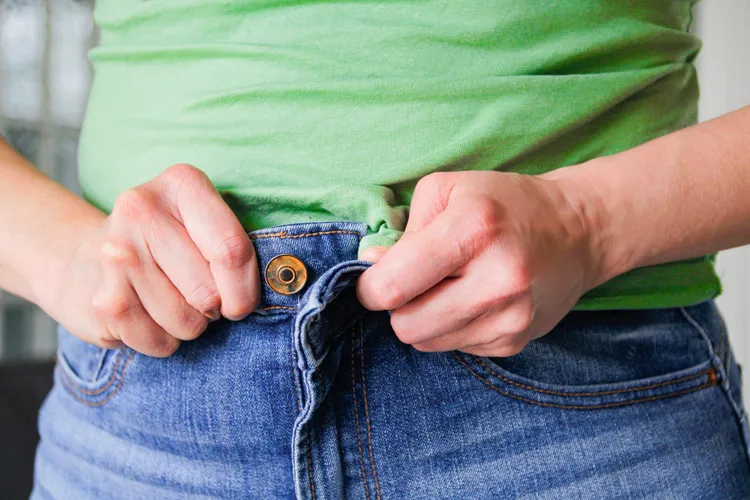

Tight clothing can include skinny jeans, belts, or even neckties that have a snug fit.
A tight fit might leave red or itchy skin, but serious health issues can arise from too-tight clothing.
Talk to a healthcare provider if you have concerning symptoms that need a diagnosis.
Choosing tight clothes may be a preference due to comfort or fashion considerations or for attire you may need for work or sports. That said, when you often wear clothes that are too tight, it can lead to health issues you may not think about.
1. Respiratory Issues
If you wear sports bras or other garments that restrict your breathing continuously and for long periods, it can compromise your lung function due to the pressure.
When this happens during exercise, typically while wearing a sports bra, it can negatively impact your basal metabolic rate, the rate at which your body burns calories.1
2. Postural Changes and Musculoskeletal Disorders
Wearing tight pants or belts regularly can put pressure on the skeletal system and nerves, potentially leading to muscle imbalance and misalignment of the pelvis over time.2
Pressure on the abdomen from tight clothing can also cause the spine to become stiffer. Even neckties may alter spinal health and posture, and lead to muscular imbalance.2
Knee Joints and Tight Clothing
Tight-waisted clothing can also affect joints, as the movement requires the muscles to use more force to transition from a sitting to a standing position. This increases the load the knee has to bear, which can, over time, cause issues.2
3. Nerve Issues
Wearing clothes that are too tight can lead to nerve compression, known as meralgia paresthetica. When a person develops this condition, they can experience various symptoms, including:34
Numbness
Pain
Tingling, prickling, chilling, or burning sensations on the skin without being touched
These symptoms can feel worse when a person moves, walks, or stands.
4. Gastrointestinal Issues
Wearing tight clothing that increases intra-abdominal pressure can lead to issues with gastrointestinal health, including the worsening of acid reflux. This is especially true when wearing tight clothing while eating.5
If a person has irritable bowel syndrome, inflammatory bowel disease, or other gastrointestinal disorders, wearing tight clothing can exacerbate their symptoms and increase pain.6 Wearing clothing that is too tight can also cause poor digestion and constipation.7
5. Brain Wave Changes
Girdles, corsets, and other tight shapewear worn around the abdomen can be uncomfortable and affect the body in various ways, one of which is by altering brain waves.
Research found that the brainwaves people experience change depending on the tightness of different types of pressure-related clothing. These changes are unlikely to be permanent and may occur due to discomfort felt while wearing the garment, without posing any long-term damage to brain health.7
6. Heart Health
Some studies have suggested that tight clothing affects circulation, which can affect heart rate and blood pressure within the cardiovascular system.2 In some cases, restricted blood flow could lead to swelling in the lower extremities and raise the risk of clots.8
7. Hormonal and Reproductive Issues
In some cases, people may also experience abnormal or irregular menstruation from regularly wearing clothing that is too tight.7 Tight and non-breathable underwear can also increase the risk of vaginal yeast infections.9
Hormonal changes in males also may be caused by wearing clothing that’s too tight, particularly underwear. Too-tight underwear can lead to a higher level of follicle-stimulating hormone, thus reducing sperm counts.10
8. Organ Health Issues
When clothing around the abdomen is too tight, it can lead to issues with blood flow to the organs. Over time, a lack of blood flow can lead to organ disorders and damage.7
How to Wear Tight Clothing Safely
The best way to wear tight clothing safely is to check in with yourself to ensure it feels comfortable and supportive. If you feel relaxed and can move freely, then the clothing is likely not too tight and is causing no problems.
How Do You Know Clothing Is Too Tight?
There’s a difference between clothing that’s tight and too tight, and there are signs that you can use to differentiate between the two. For example, seeing pressure marks or red marks on the skin after removing a garment could indicate that it’s too tight against the skin.
However, seeing red marks on their own doesn’t always indicate that clothing is too tight, as some people may have more sensitivity to tightness or mark more easily than others.
In a 2021 study, the most commonly reported symptoms caused by tight clothing were:11
Pain (65.6%)
Itching (46.2%)
Sense of heaviness (41.9%)
Numbness (18.8%)
Tight clothing or belts can irritate the lateral femoral cutaneous nerve, leading to numbness, and pain due to meralgia paresthetica. The risk increases with pregnancy, obesity, or diabetes.4
When Tight Clothing Is More Than Uncomfortable
Most issues from tight clothing improve within a few hours once you change into looser, more breathable items—but some symptoms can signal nerve compression, breathing problems, or another issue that should not be ignored.
Common problems that usually improve after removing the clothing: Temporary skin marks, chafing, heartburn or reflux after a tight waistband, mild bloating, feeling restricted when taking a deep breath, itching or irritation from tight non-breathable underwear, and brief numbness or tingling
Garments most often linked to these issues: Shapewear, corsets, tight sports bras, skinny jeans, narrow waistbands, leggings with a tight compression band, and synthetic underwear that traps moisture811
Signs the fit may be too tight: You cannot sit, bend, or breathe comfortably; you notice deep indentations that last; the area feels numb, tingly, or painful; or symptoms keep returning every time you wear the item.
If symptoms continue, it may help to switch to a looser size, choose softer stretch fabrics, limit wear time, and avoid garments that compress the same area every day.
When to See a Healthcare Provider
Stop wearing the garment and contact a healthcare provider if you have:
Ongoing thigh numbness or burning pain
Worsening swelling
Weakness or trouble walking
Shortness of breath
Severe pain
Loss of sensation that does not go away after changing clothes
Seek urgent care right away for serious breathing trouble, marked leg swelling, sudden weakness, or severe pain that feels out of proportion to a simple pressure mark.
Verywell Health uses only high-quality sources, including peer-reviewed studies, to support the facts within our articles. Read our editorial process to learn more about how we fact-check and keep our content accurate, reliable, and trustworthy.
Kipp S, Leahy MG, Sheel AW. Sports bra restriction on respiratory mechanics during exercise. Med Sci Sports Exerc. 2024 Jun 1;56(6):1168-1176. doi:10.1249/MSS.0000000000003403
Kalyan R, Arora B, Neha. Biomechanical effects of restrictive clothing on human movement and musculoskeletal function: A narrative review. International Journal of Physiology, Health and Physical Education. 2026. doi:10.33545/26647265.2026.v8.i6a.179
Dalal S, Berger AA, Orhurhu V, Kaye AD, Hasoon J. Peripheral nerve stimulation for the treatment of meralgia paresthetica. Orthop Rev (Pavia). 2021 May 29;13(2):24437. doi:10.52965/001c.24437
Wang VC, Mullally WJ. Pain Neurology. Am J Med. 2020 Mar;133(3):273-280. doi:10.1016/j.amjmed.2019.07.029
Mitchell DR, Derakhshan MH, Wirz AA, Ballantyne SA, McColl KEL. Abdominal compression by waist belt aggravates gastroesophageal reflux, primarily by impairing esophageal clearance. Gastroenterology. 2017 Jun;152(8):1881-1888. doi:10.1053/j.gastro.2017.02.036
Canadian Digestive Health Foundation. Dressing with IBS and other digestive health issues.
Liu Y, Wang Y. Clothing pressure alters brain wave activity in the occipital and parietal lobes. Transl Neurosci. 2019 Apr 23;10:76-80. doi:10.1515/tnsci-2019-0013
The Ohio State University. How fashion trends and your clothing can affect your health.
KidsHealth. Vaginal yeast infections.
Mínguez-Alarcón L, Gaskins AJ, Chiu YH, et al. Type of underwear worn and markers of testicular function among men attending a fertility center. Hum Reprod. 2018 Sep 1;33(9):1749-1756. doi:10.1093/humrep/dey259
Sherazi SA, Awan W, Kazmi M, Mahmood K, Awan AM. Perils of tight clothing; a survey report. International Islamic Medical Journal. 2021;3(1):6-15.
