
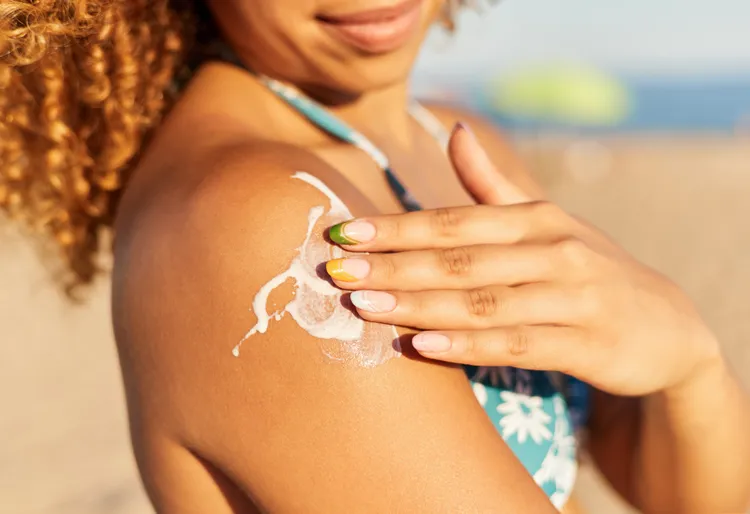

Use at least one ounce of sunscreen to cover your exposed skin, and one teaspoon for your face, to ensure proper protection.
Reapply sunscreen every two hours while outside, or after swimming or sweating, to maintain its effectiveness.
Sunscreen should be worn even on cloudy days, as up to 80% of UV rays can still reach your skin.
Wearing sunscreen every day is one of the best ways to protect your skin from sun damage and lower your risk of skin cancer. However, common mistakes can reduce its effectiveness, leaving your skin vulnerable to UV damage.1
1. Not Applying Enough Sunscreen
Most people use only about 25%-50% of the recommended amount of sunscreen. At the very least, the average adult requires about 1 ounce of sunscreen to cover their exposed skin adequately.2 That’s roughly the amount that fits inside a full shot glass.
You may need to apply more sunscreen, depending on your body size and how much skin you need to cover. For your face, experts recommend at least one teaspoon.2 Using less than this amount can reduce your sun protection.
2. Forgetting to Reapply
One survey found that about 65% of people said they often forget to reapply their sunscreen.2 This is a mistake because sunscreens can wear off.
You should apply sunscreen about 15 minutes before heading outdoors. Make sure your skin is dry.3 Then reapply at least every 2 hours while outside, or after sweating or swimming.2
3. Not Applying on a Cloudy Day
Many people think they only need to apply sunscreen if the sun is out. However, even on cloudy days, up to 80% of UV rays can penetrate your skin.2
Experts recommend wearing sunscreen whenever you’re outdoors, even if the sun isn’t shining.
4. Using Expired Sunscreen
Expired sunscreens may not protect your skin as well. That’s because the active ingredients can break down over time. The Food & Drug Administration (FDA) requires sunscreen’s strength to last for at least three years.2
You should discard expired sunscreen products. If the bottle doesn’t have an expiration date, be sure to write the purchase date so you know when to get rid of it.
5. Not Using a High Enough SPF
The sun protection factor (SPF) is a scale that indicates how well a sunscreen protects your skin from UVB rays.3
Most experts recommend using sunscreen products daily with an SPF of at least 30. When you’re outdoors for an extended period of time, it’s a good idea to use sunscreen with an SPF of 50.3
SPF and Reapplying
Some people mistakenly believe that if their sunscreen has a higher SPF, they don’t have to reapply. But this is a misconception; you still need to reapply just as often.
6. Missing Spots on Your Body
Many people miss important areas of the body when applying sunscreen. Be sure to cover the tops of your feet, your neck, your ears, the top of your head, and the backs of your legs. About 20% of melanomas in women are found on the back of the legs.4
Skin cancer can also affect your lips, so it’s important to apply a lip balm with SPF.
7. Relying Only on Sunscreen
No sunscreen can block 100% of the sun’s UV rays. That’s why you shouldn’t rely solely on sunscreen for sun protection. Additional ways to protect your skin from the sun include:3
Seek shade whenever possible
Avoid being outdoors when the sun is at its strongest, which is from about 10:00 a.m. to 3 p.m.
Wear sun-protective clothing, wide-brimmed hats, and sunglasses when outdoors
What to Look for in a Sunscreen
When purchasing sunscreen, look for products that:4
Have broad-spectrum protection (protects against both UVA and UVB rays)
Have an SPF of 30 or higher
Are water-resistant (if you’re swimming or sweating)
Are not expired
Type of Sunscreen
Experts say the best type of sunscreen is the one you’ll use. None are necessarily better than others. However, when using sprays, it can easy to miss certain areas of the body.4
Are Sunscreens Safe?
Some research suggests that certain ingredients in chemical sunscreens, such as oxybenzone, can be absorbed into the bloodstream.5 However, this doesn’t mean it’s necessarily harmful. Most skin experts still advise people to use sunscreen for its well-documented benefits.
The safest sunscreen options are mineral sunblocks. Their ingredients, zinc oxide and titanium oxide, sit on the skin’s surface and reflect UV rays.6
Sunscreen and Skin Cancer
A landmark study found that people who used sunscreen daily had about a 50% lower risk of developing melanoma (the most deadly form of skin cancer) compared to those who used it less often.7
Verywell Health uses only high-quality sources, including peer-reviewed studies, to support the facts within our articles. Read our editorial process to learn more about how we fact-check and keep our content accurate, reliable, and trustworthy.
