
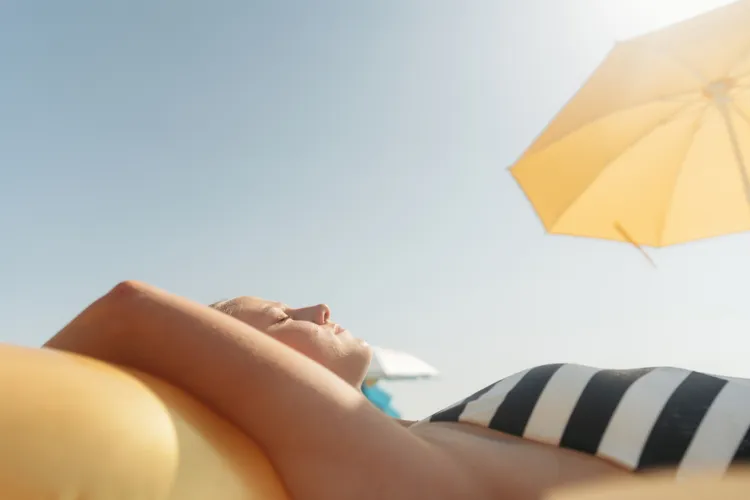

Tanmaxxing, a trend where people skip sunscreen to tan during peak UV hours, poses serious health risks. Dermatologist Julia E. Tzu, MD, explains why this behavior significantly increases the risk of skin cancer.
More people are using the UV index to find the best time to tan, but not to avoid sun exposure. This behavior is part of the “tanmaxxing” trend on social media, where skipping sunscreen is encouraged for a bronzed look.
Sunburns and excessive sun exposure increase your risk of skin cancer, and tanning beds are equally unsafe.1 We consulted Julia E. Tzu, MD, a triple board-certified dermatologist, to understand the dangers of tanmaxxing.
*This interview has been edited and condensed for clarity.
Q: I’ve seen many Gen Z wellness influencers say if they’re going to get cancer from something anyway, they might as well have a tan and look good. What do you want people with this attitude to know about the risks of “tanmaxxing”?
Tzu: This is shocking coming from Gen Z, who care so much about skin care and have this idea of “looksmaxxing.” There is a physical consequence to having skin cancer and skin cancer treatment. Good skin care and good sun behavior go hand in hand with looksmaxxing. To me, having skin that is not sun-damaged and is free of brown spots and wrinkles is looksmaxxing.
I don’t think people should take the fatalistic attitude that they’re definitely going to get cancer, so they might as well do all the riskiest things. It is not certain that everyone will get cancer, but by undergoing these risky behaviors, you are greatly increasing the chance that you will get cancer.
You might say, “Well, all of my relatives have had skin cancer, so I’m going to get one anyway.” But you could actually delay or reduce your risk and thereby get skin cancer later in life, like in your 70s, versus when you’re 30.
Q: Tanmaxxers often go outside when the UV index is at its highest, and skip sunscreen because it could “cause cancer.” Why is this habit especially risky, and is there any evidence that sunscreen causes cancer?
Tzu: It’s very well established that skin cancer is directly related to cumulative exposure to UV radiation.2 People should look at the UV index and try to choose the times with the lowest UV index to go outside. That’s why this index was developed.
There’s more evidence that the sun causes skin cancer than that sunscreen causes skin cancer. I’m not aware of any studies that show that sunscreen causes skin cancer.3 There have been some studies demonstrating that sunscreens could have a hormonal disruption effect.45
Even if any of the weak data were actually true, use a physical (mineral) sunscreen. All of the alarming pseudodata on sunscreens causing problems with the body are mostly about chemical sunscreens. These are also the types that can harm coral reefs.6
And if you are really afraid of sunscreen, wear UV clothing with UPF or a hat to protect you from sun exposure.
Q: Most of us have heard that tanning beds are dangerous, but just how dangerous are tanning beds, really? What about spray tans or self-tanners?
Tzu: If your goal is to look tan, do it in a safe way. Tanning beds are not a safer option than tanning outside. It all depends on the duration and distribution of that UV exposure, whether it’s through a tanning bed or the sun.
If you think a tan is beautiful, just use a self-tanner or a spray tanner. There are some risks associated with that, but it’s far less than the risk from natural tanning. In general, I stay away from aerosols, whether it’s hair spray or sunscreen sprays, because there is an inhalational component that we haven’t really studied.
From an ultra-conservative point of view, I feel pretty safe using the sunless tanners. You will decrease your chances of photoaging and developing wrinkles and premature brown spots if you get a spray tan or a sunless tanner rather than getting a real tan. If your goal is looksmaxxing, don’t get a real tan.
Verywell Health uses only high-quality sources, including peer-reviewed studies, to support the facts within our articles. Read our editorial process to learn more about how we fact-check and keep our content accurate, reliable, and trustworthy.
National Cancer Institute. Skin cancer treatment (PDQ)—patient version.
Centers for Disease Control and Prevention. Sun safety facts.
Sander M, Sander M, Burbidge T, Beecker J. The efficacy and safety of sunscreen use for the prevention of skin cancer. CMAJ. 2020;192(50):E1802-E1808. doi:10.1503/cmaj.201085
Dutta S, Sengupta P, Chhikara BS, Formicki G, Rosas IM, Roychoudhury S. Polycystic ovary syndrome (PCOS)-specific risk appraisal of the sunscreen ultraviolet (UV) filters (oxybenzone/octinoxate). Toxics. 2025;13(11):927. doi:10.3390/toxics13110927
Jaskulak M, Cinkusz M, Franchuk K, Zorena K. Endocrine and reproductive health considerations of sunscreen UV filters: insights from a comprehensive review 2014-2024. Curr Environ Health Rep. 2025;12(1):28. doi:10.1007/s40572-025-00492-9
National Oceanic and Atmospheric Administration. Skincare chemicals and coral reefs.
