

Your skin can reflect what’s going on inside the body, including psychological stress.
Stress can affect your skin through both biological and behavioral mechanisms.
Being stressed can worsen skin conditions, while having a skin condition can also make you feel stressed, creating a cycle.
Have you ever noticed that during periods of stress, your skin tends to flare up? This might look like an acne breakout during a stressful period at work, or maybe your eczema got triggered during a breakup. That’s not just a coincidence. Stress and your skin are closely linked—here’s how.
How Does Stress Impact Your Skin?
When stress becomes chronic or uncontrolled, it can affect your body in various ways, including causing new or worsening existing skin conditions.1
Some ways that stress can affect your skin include:2
Breaking down collagen and elastin (creating fine lines and wrinkles)
Increasing itchiness
Increasing oil production
Slowing wound healing
Triggering hair shedding
Worsening skin conditions
Stress can also impact your behaviors. For instance, you might spend less time cleansing or caring for your skin. Or, you may start picking at your skin as a form of stress relief.3 All of this can further damage your skin.
There’s also a bidirectional relationship between stress and your skin. This means that being stressed can trigger skin issues, but skin issues can also make you feel stressed, creating a vicious cycle.
Common Skin Conditions Affected By Stress
Stress can affect many health conditions, including:
Eczema (atopic dermatitis): Stress doesn’t necessarily cause eczema, but it can make flares worse. Your skin may feel itchier, and your flares may last longer due to stress-induced disruptions in wound healing.4
Acne: When you’re stressed, your body experiences hormone fluctuations that can increase oil production, clogging pores and triggering acne in people who are prone to it. Stress-induced inflammation can also worsen existing acne.5
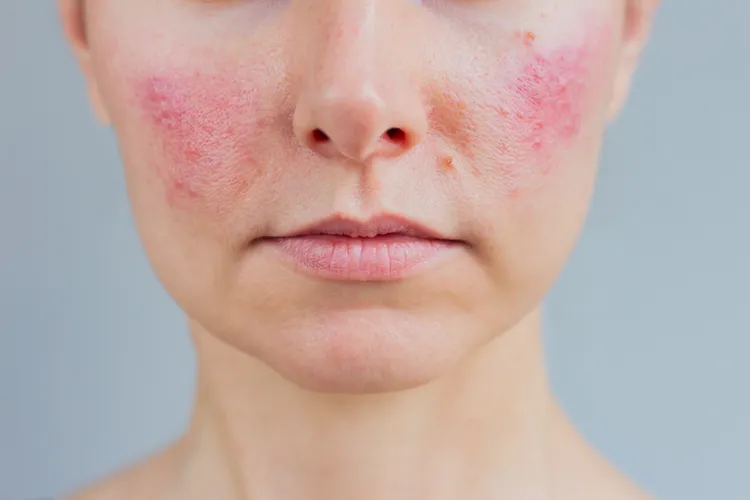
Rosacea: Stress is a common trigger, increasing inflammation and disrupting the skin barrier, which can trigger rosacea flares.6 Research also shows that people with rosacea are more likely to feel stressed, and also have higher long-term risk of developing anxiety and depression.7
Psoriasis: Stress doesn’t necessarily cause psoriasis. However, it can trigger a flare of psoriasis if you already have the condition.4 Psoriasis lesions, especially those on the face and neck, can also contribute to social anxiety and stress.8
More Skin Conditions Exacerbated by Stress
Those aren’t the only skin conditions that are related to stress. The following skin conditions can also be triggered or worsened by a period of stress:9
Excessive sweating (hyperhidrosis)
Prurigo
Hives (urticaria)
Lichen planus
Scalp rash (seborrheic dermatitis)10
Hair loss (alopecia areata)11
Hair shedding (telogen effluvium)4
Skin picking (dermatillomania)3
Skin aging12
Perioral dermatitis7
Vitiligo13
Understanding the Biological Link Between Stress and Skin
There are so many complex interactions between stress and skin health that scientists have given it a name: the “skin-brain axis.”14
To understand the “skin-brain axis” in basic terms, think of the process like this: the stress response affects both the sympathetic nervous system and the hypothalamic-pituitary-adrenal axis (the communication pathway between the brain and stress hormones). This results in the release of hormones and molecules such as cortisol, catecholamines, neuropeptides, androgens, and more.15
These molecules can have many different effects on the skin that make you more susceptible to skin problems, including:1516
Altered hypothalamic–pituitary–adrenal (HPA) axis activity17
Impaired skin barrier function
Impaired wound healing
Release of pro-inflammatory cytokines (which trigger inflammation)
Suppressed immunity
But it gets even more complex. The skin is not only a target for stress hormones but also produces them, along with other molecules such as cytokines, chemokines, and neurotrophins. These molecules can cross the blood-brain barrier and worsen inflammation, stress, and other psychiatric symptoms.18
Ultimately, scientists are still trying to understand what happens to your skin when you’re stressed, and why. Most current research on the topic focuses on animals rather than humans.18
Reduce Stress to Help Keep Skin Healthy
If you’re trying to take care of your skin, you might want to consider stress management strategies alongside dermatological care, such as ointments, creams, or medications.
Reducing your stress may help heal your skin or reduce the frequency or severity of flares in any skin conditions you might have.24
Verywell Health uses only high-quality sources, including peer-reviewed studies, to support the facts within our articles. Read our editorial process to learn more about how we fact-check and keep our content accurate, reliable, and trustworthy.
American Psychiatric Association. Psychodermatology: Addressing the skin — mental health connections.
American Academy of Dermatology Association. Feeling stressed? It can show in your skin, hair, and nails.
Chesivoir EK, Collins M, Grant JE. Emotional dysregulation in skin picking disorder. Cogn Ther Res. 2024;48(1):156-163. doi:10.1007/s10608-023-10420-6
American Academy of Dermatology Association. 6 skin and hair conditions linked to stress.
Siddiqui I, Rais U, Tahir M. Exploring stress-induced mechanisms in acne pathogenesis. 2024. doi:10.21203/rs.3.rs-4477781/v1
Grafanaki K, Bakoli Sgourou D, Maniatis A, Pasmatzi E. The exposomal imprint on rosacea: More than skin deep. Journal of the European Academy of Dermatology and Venereology. 2026;40(3):387-403. doi:10.1111/jdv.70112
Andrén J, Najeeb M, Ludwig RJ, Curman P. Increased long-term risks of depression, anxiety, stress, and suicidality in rosacea and perioral dermatitis. J Affect Disord. 2026;394(Pt B):120683. doi:10.1016/j.jad.2025.120683
Łakuta P, Marcinkiewicz K, Bergler-Czop B, Brzezińska-Wcisło L, Słomian A. Associations between site of skin lesions and depression, social anxiety, body-related emotions and feelings of stigmatization in psoriasis patients. Advances in Dermatology and Allergology/Postȩpy Dermatologii i Alergologii. 2018;35(1):60. doi:10.5114/pdia.2016.62287
Goyal N, Prabhu SS. Stress and common dermatological disorders: the psychophysiological dermatoses. Clinical Dermatology Review. 2023;7(4):327-332. doi:10.4103/cdr.cdr_8_22
Saif GAB, Alotaibi HM, Alzolibani AA, et al. Association of psychological stress with skin symptoms among medical students. Saudi Medical Journal. 2018;39(1):59. doi:10.15537/smj.2018.1.21231
Ahn D, Kim H, Lee B, Hahm DH. Psychological stress-induced pathogenesis of alopecia areata: autoimmune and apoptotic pathways. IJMS. 2023;24(14):11711. doi:10.3390/ijms241411711
Pujos M, Chamayou-Robert C, Parat M, et al. Impact of chronic moderate psychological stress on skin aging: exploratory clinical study and cellular functioning. Journal of Cosmetic Dermatology. 2025;24(1):e16634. doi:10.1111/jocd.16634
Cao C, Lei J, Zheng Y, Xu A, Zhou M. The brain-skin axis in vitiligo. Arch Dermatol Res. 2024;316(8):607. doi:10.1007/s00403-024-03362-w
Marek-Jozefowicz L, Czajkowski R, Borkowska A, et al. The brain–skin axis in psoriasis—psychological, psychiatric, hormonal, and dermatological aspects. IJMS. 2022;23(2):669. doi:10.3390/ijms23020669
Graubard R, Perez-Sanchez A, Katta R. Stress and skin: an overview of mind body therapies as a treatment strategy in dermatology. Dermatology Practical & Conceptual. 2021;11(4):e2021091. doi:10.5826/dpc.1104a91
Zhang H, Wang M, Zhao X, et al. Role of stress in skin diseases: A neuroendocrine-immune interaction view. Brain, Behavior, and Immunity. 2024;116:286-302. doi:10.1016/j.bbi.2023.12.005
Evers AWM, Van Beugen S. How stress affects the skin: from designs to mechanisms. Br J Dermatol. 2021;185(1):12-13. doi:10.1111/bjd.20397
Tan CC, Soh KV, Wang E, Choi ECE. The brain-skin connection: A narrative review of neuroendocrine and immune pathways. JAAD International. 2026;24:112-123. doi:10.1016/j.jdin.2025.10.008
